Turbulent Audio’s Big Business combines a three-band EQ with a separate clean boost
The $199 boutique pedal adds variable crossover points and internal 18-volt headroom to an end-of-chain tone-shaping format.
· Edited by Peter Luha
Credit: Turbulent Audio (via source)
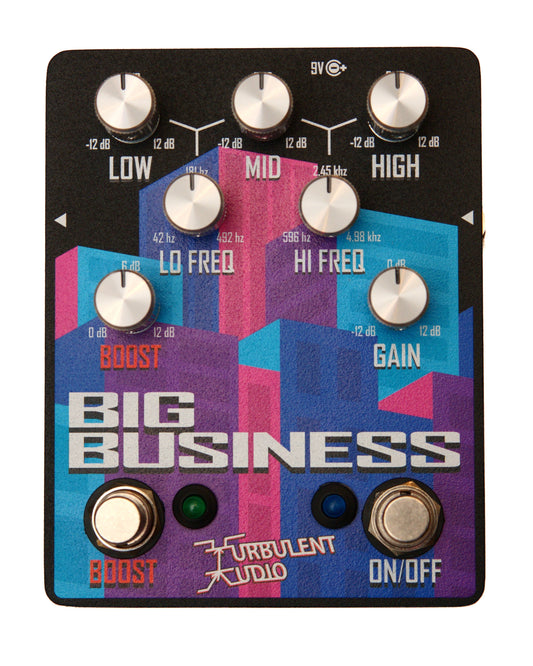
Turbulent Audio has released Big Business, a $199 EQ-and-boost pedal built around three broad frequency bands and a separately switchable clean boost. The Morristown, New Jersey builder presents it as a flexible preamp and end-of-chain sculpting tool rather than a conventional graphic EQ, with large Low, Mid and High controls joined by adjustable Low Frequency and High Frequency crossover controls.
Those crossover controls are the key design choice. Instead of fixing the boundaries between bass, midrange and treble, Big Business lets the player move the points where those broad bands meet. Turbulent Audio says the bands use flat responses and predictable transitions, so adjustments are intended to reshape the overall balance without the narrow peaks associated with many multi-slider EQ pedals. The boost has its own footswitch and operates independently from the EQ section.
The circuit runs internally at 18 volts for additional headroom while accepting a standard pedalboard power connection. That matters for players placing the unit after gain pedals or at the end of a busy effects chain, where a lower-headroom EQ can become an unintended source of compression or clipping. Delicious Audio’s launch coverage also points to three practical roles: an always-on preamp, a focused mid boost and a final corrective stage before the amplifier or recording interface.
Big Business is available directly from Turbulent Audio. Its appeal is not that it invents equalization or clean boost, but that it joins both functions in a compact layout with continuously adjustable crossover behavior. That gives guitarists a more structural way to tune a rig for different rooms, amplifiers and instruments without rebuilding the rest of the signal chain.
Credit: YouTube
Why it matters
Variable crossover points make the pedal more adaptable than a fixed three-band EQ, while the independent boost can cover level changes without disturbing the chosen curve.
From Guitar News to Guitar Progress
Discover it here. Learn how it works. Practice it until it's yours.
“Find natural harmonics on every string at frets 12, 7, and 5. Make each one ring like a bell.”
Related

Richie Kotzen teases a baby-blue Stratocaster for 2027
The one-off-looking build keeps his figured-top, gold-hardware formula but points to a slimmer neck and a possible new Fender chapter.
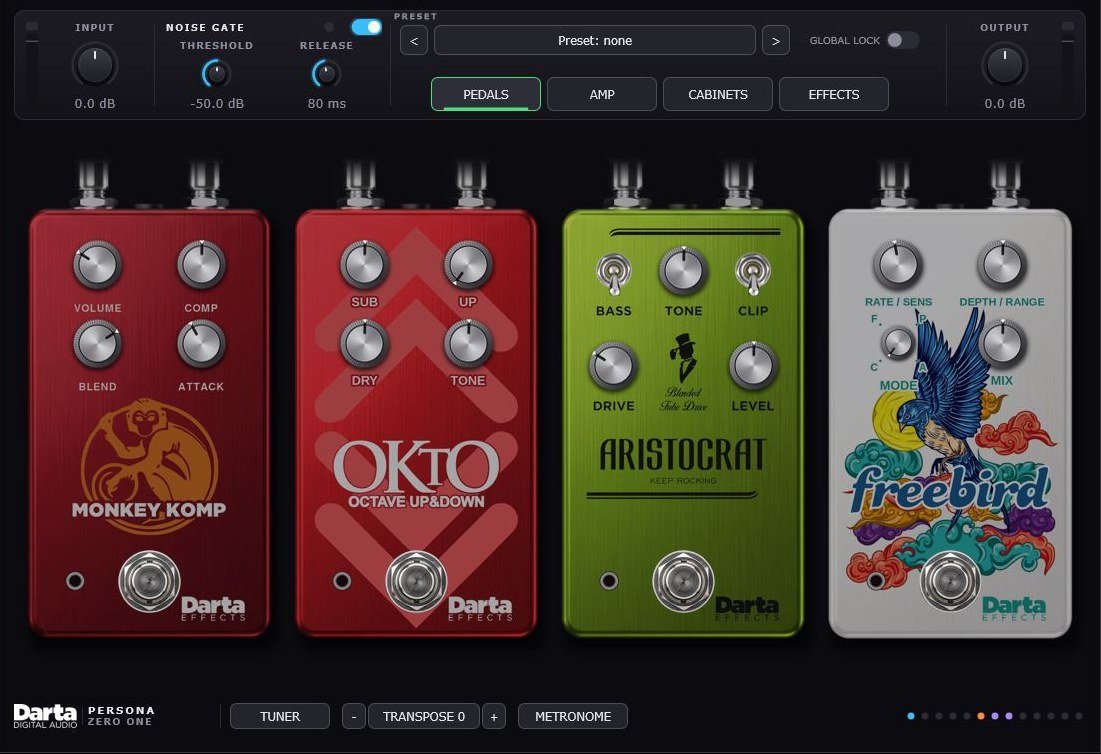
Darta Persona: Zero One combines a captured amp, four pedals and NAM support
The Brazilian plugin packs a complete guitar rig into VST3, AU and standalone formats at a R$249 launch price.

Teenage Engineering turns the EP-35 into a portable amp, recorder and wireless performance hub
The $399 battery-powered 35-watt amp combines guitar, microphone and line inputs with built-in effects, USB multitrack audio and Auracast linking.

Fender gives Mark Hoppus’ Stoned Fruit Jaguar Bass a 182-hour made-to-order release
The $1,499.99 Guava Green signature bass recreates Hoppus’ current stage instrument and lets buyers place its psychedelic fruit decals themselves.