Behringer says it is planning hundreds of $10–15 pedals
The company has outlined a vast low-cost pedal program spanning analog, digital, bass and open-source designs, but has not set a launch date.
· Edited by Peter Luha
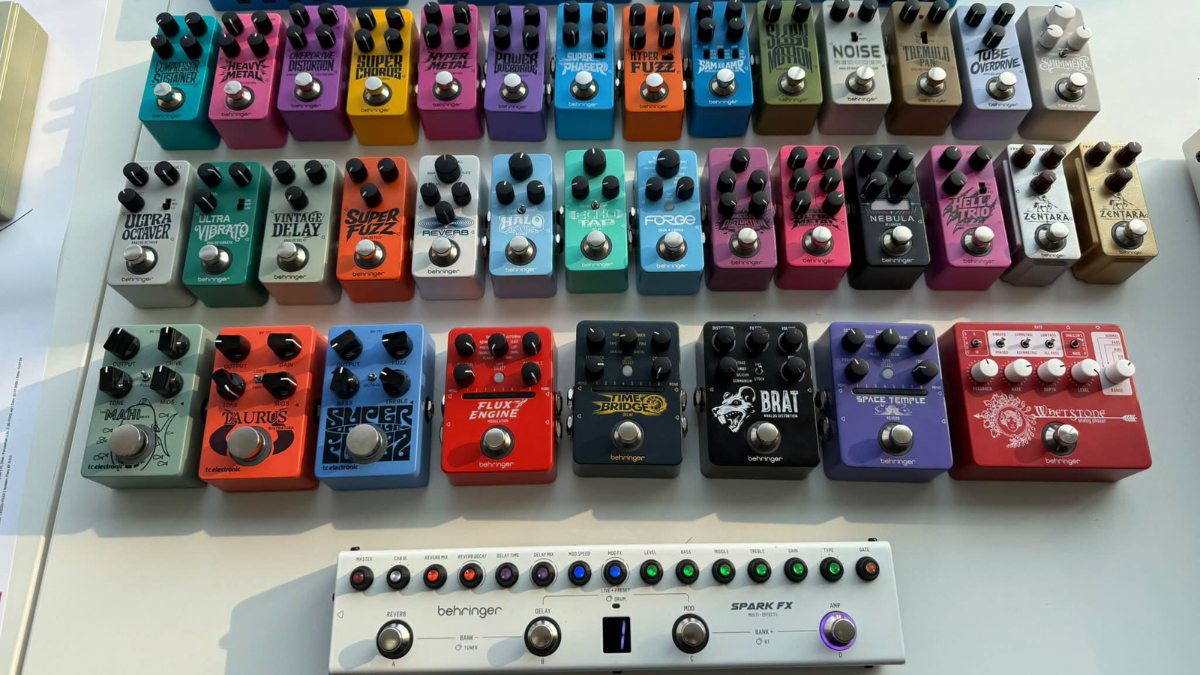
Credit: Behringer (via source)
Behringer says it is planning a range of 200 to 300 metal-enclosure pedals with target prices of $10 to $15. In a company social post reported by Guitar World, the manufacturer described a mix of analog and digital effects, legacy circuits and new designs, including bass models. It also said some products would be open-source or hackable, an unusually explicit invitation for users to inspect or modify designs at mass-market prices.
The preview image shows concepts including the Brat distortion, Time Bridge delay, Space Temple reverb and Whetstone phaser, alongside compact Slow Motion and Noise models and previously introduced Zentara variants. Behringer has not supplied a release schedule, final model list or retail availability. The quoted prices therefore remain targets for a planned range, not prices attached to products customers can currently order.
The scale is the consequential part of the announcement. A catalog this large at impulse-buy pricing could widen access to basic effects, but it would also intensify existing arguments over circuit lineage, manufacturing scale and the economics of independent pedal design. Guitar.com’s follow-up records early resistance from boutique builders, showing that the proposal is already functioning as an industry story before any individual pedal reaches the market.
Why it matters
If delivered at the stated scale and price, the program could reset entry-level pedal economics while increasing pressure on small builders and retailers.
From Guitar News to Guitar Progress
Discover it here. Learn how it works. Practice it until it's yours.
“Play your favourite piece entirely from memory. No tab, no paper, no looking at your hands.”
Related
Fender says Corona factory WARN notice covers holiday shutdown, not layoffs
The company says 533 employees were notified under a newly formalized process for its annual year-end quiet weeks and are expected back in the new year.

Josh Scott Is Opening a Nearly 400-Pedal Reverb Shop
The October 21 sale spans JHS prototypes, one-off builds, vintage pedals, amps, guitars, keys and artifacts from the JHS Show.

Fender rebuilds Fender.com around AI gear guidance and upcoming sound demos
The brand's new global platform combines products, editorial content and player services, with Ask Fender launching first in the US.

Paul Reed Smith joins Guitar Center’s RockWalk after five decades of guitar building
John Mayer inducted the PRS founder during Crossroads in Austin, placing a living instrument designer alongside RockWalk pioneers such as Les Paul, Jim Marshall and Robert Moog.